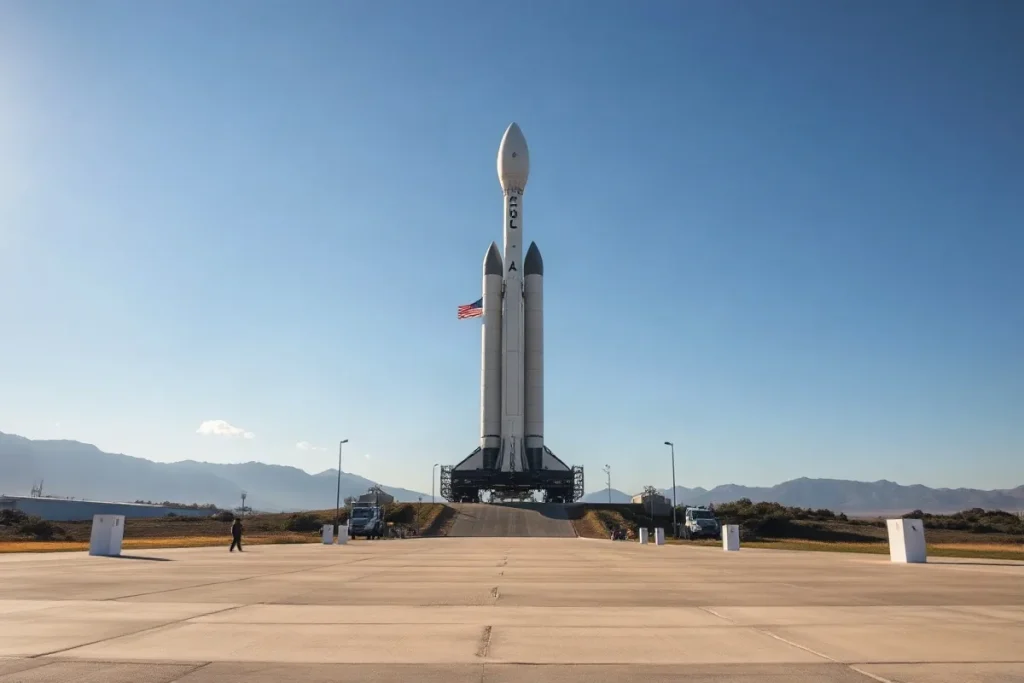
Starship’s Orbital Launch: A Critical Milestone
SpaceX plans to launch its fully integrated Starship spacecraft into orbit from its Texas facility by October 2026. This mission is the first fully stacked Starship-Super Heavy launch aimed at demonstrating the vehicle’s viability for commercial orbital flights. Success in this test could revolutionize the space industry by drastically reducing launch costs and boosting payload capacity.
The Starship system is designed to carry over 100 metric tons to low Earth orbit, far surpassing the payload capabilities of existing commercial rockets. The October launch will test key systems including Super Heavy’s booster separation and Starship’s orbital insertion, critical for future commercial missions.
Background on Starship and SpaceX’s Ambitions
SpaceX has been developing Starship since 2016 as part of its vision to enable human colonization of Mars and expand commercial space access. The company has invested billions into the program, with the Texas launch site hosting multiple prototype tests since 2020. The orbital launch attempt follows a series of suborbital tests that validated Starship’s Raptor engines and heat shield technology.
Elon Musk, CEO of SpaceX, has stated that Starship aims to reduce launch costs to below $10 million per flight, a fraction of traditional rocket expenses. This cost efficiency is expected to open new markets in satellite deployment, space tourism, and interplanetary missions.
Stakeholders and Industry Impact
SpaceX’s major commercial customers include satellite operators, government space agencies, and emerging space tourism firms. The success of the Starship orbital launch could secure contracts worth billions, as it offers unprecedented payload volumes and reusability. NASA has also expressed interest in Starship for lunar missions, citing its heavy lift capacity.
Competitors such as Blue Origin and United Launch Alliance are closely monitoring Starship’s progress, as it challenges their market share in heavy-lift launches. The global commercial launch sector generated nearly $9 billion in revenue in 2025, and Starship’s entry could significantly expand this market.
Technical Challenges and Risk Factors
The complexity of the Starship launch involves multiple risk points, including the Super Heavy booster’s 33 Raptor engines and the high-speed aerodynamic stresses during stage separation. Previous tests have experienced failures during landing attempts, highlighting the technical difficulty of full reusability.
SpaceX engineers have implemented design refinements to address prior issues, such as improved engine cooling and upgraded avionics. The orbital launch will also test Starship’s heat shield, which must withstand temperatures exceeding 1,600 degrees Celsius during atmospheric reentry.
Future Prospects for Commercial Space Travel
If successful, Starship’s orbital capability will enable next-generation satellite constellations, reducing global internet latency and expanding coverage. It will also facilitate space tourism by supporting larger crew modules and more frequent flights. SpaceX envisions Starship playing a central role in the emerging interplanetary economy.
Additionally, Starship’s payload capacity and cost structure could accelerate scientific missions, including asteroid mining and space station resupply. The October 2026 launch is thus a critical test of technology that could reshape the economics and accessibility of space travel.
Takeaway: SpaceX’s Starship orbital launch in October 2026 represents a pivotal test with the potential to transform commercial spaceflight through unprecedented payload capacity and cost reductions.
