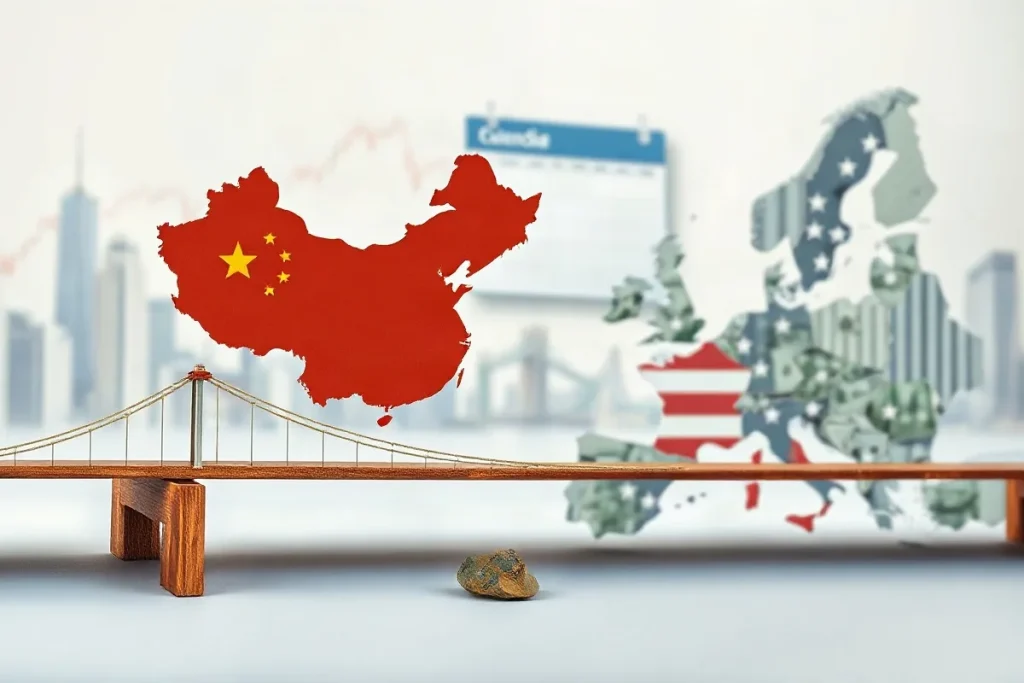
China says it will continue approving rare-earth export licences for Europe even if its trade truce with the United States ends in January. The assurance, delivered by Commerce Ministry spokesperson He Yadong, separates EU shipments from the fate of the U.S.-China arrangement. It offers European buyers near-term reassurance, but does not remove the risk that Beijing could use supply access as leverage in negotiations.
Beijing makes a separate commitment to Europe
He told CNBC that China was willing to keep approving licences for rare-earth exports to Europe, responding to a question about the approaching U.S. deadline. His statement concerns the continuation of approvals; it does not establish that every shipment will move without delay or that export controls have been lifted.
The distinction matters because rare earths are used in products and industrial supply chains, while China has the power to control access through licensing. The assurance addresses European supply directly rather than promising that the U.S.-China trade arrangement will be renewed. For EU companies, the practical issue remains whether licences translate into predictable deliveries.
The U.S. truce has a January deadline
China tightened restrictions on rare-earth exports last October, including controls applying to products containing as little as 0.1% of China-sourced rare earths. The move followed a U.S. rule extending an American blacklist to majority-owned subsidiaries of Chinese companies on the entity list, potentially affecting about 20,000 Chinese entities.
The two countries agreed to suspend the measures for one year after a meeting between Chinese President Xi Jinping and U.S. President Donald Trump in late October 2025. Before their latest summit last month, U.S. Treasury Secretary Scott Bessent said the truce had been extended by two months, taking the deadline to January. China’s message to Europe is therefore significant precisely because the U.S. arrangement remains time-limited.
EU-China talks include a proposed “green channel”
Trade tensions between Brussels and Beijing eased last week after European trade commissioner Maroš Sefčovič met Chinese Commerce Minister Wang Wentao in Beijing. China said it was willing to use a “green channel” mechanism to keep rare earths moving to Europe, linking the proposal to discussions over trade between the two sides.
Beijing also asked the EU to support Chinese imports in certain dual-use sectors. That request gives the supply assurance a negotiating dimension: access to rare earths is being discussed alongside trade interests, rather than as an isolated commercial matter.
Europe faces a supply-security test
The European Union Institute for Security Studies has warned that Beijing may continue disrupting supply in the coming months and years to seek further concessions. It has also cautioned that a sense of security could weaken Europe’s resolve to diversify critical raw-material production. China’s current promise may ease immediate concern, but does not settle the longer-term question of how exposed European industry remains to decisions made in Beijing.
The Council on Foreign Relations has described China’s use of material supply chains for geopolitical advantage since the Busan détente in October 2025. The New York Times has reported that rare-earth controls became a central trade issue after China introduced export licensing rules in April 2025, following steep U.S. tariffs. Together, these developments put the EU’s “green channel” proposal in a broader contest over who controls access to essential materials.
Brussels reviews the negotiations
European Commission leaders are meeting in Brussels on Thursday and Friday and are expected to review the details of trade negotiations with China. Their task includes weighing the immediate value of continued licence approvals against the need for a more resilient supply base. The talks also sit alongside China’s request concerning imports from dual-use sectors.
For businesses, the key distinction is between a political assurance and dependable access. China has said rare-earth exports to Europe will continue regardless of the U.S. deal’s expiration, but the licensing system remains central to whether goods can move. The EU’s next decisions will help show whether the proposed channel improves continuity or simply leaves supply dependent on ongoing negotiations.
Takeaway: China’s promise protects the prospect of continued EU shipments beyond January, but does not end Europe’s exposure to licensing decisions or trade bargaining.
References
- threads.com — “China indicates rare earths will keep flowing to EU, regardless of U.S. trade deal expiration”
- iss.europa.eu — “False sense of security: European complacency on rare earths is the wrong answer to the US-China trade truce | European Union Institute for Security Studies”
- Council on Foreign Relations — “Dismantling China’s Supply-Chain Weapon”
- csis.org — “Trump Strikes a Deal to Restore Rare Earths Access”
- The New York Times — “China’s Continued Control of Rare Earths Looms Over Trump-Xi Meeting – The New York Times”