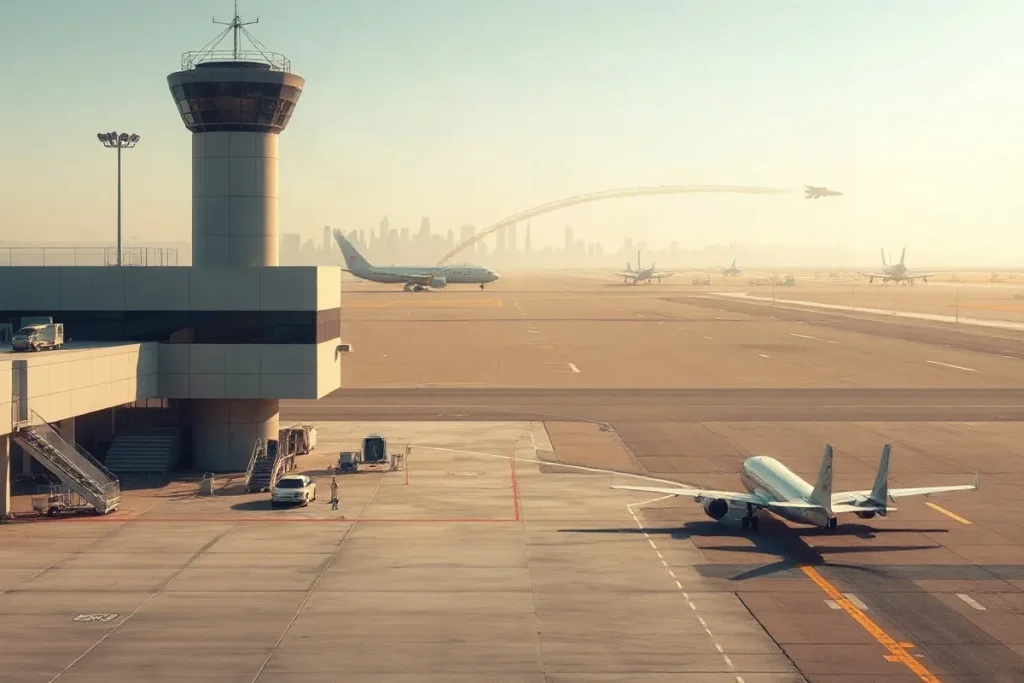
President Donald Trump said Saturday that the United States may join Saudi Arabia’s military response to the Houthis after an attack on Riyadh’s King Khalid International Airport killed 12 people and injured 309. Saudi officials are asking Washington for urgent defense support, raising the prospect of U.S. action against the Iran-backed group in Yemen. Trump said a decision would follow a rapid review; he did not commit to joining the campaign.
Trump leaves the door open to U.S. action
Asked outside the White House whether Washington would back Saudi strikes, Trump said the administration would consider it and decide quickly. His remarks came after attacks on the airport’s passenger terminal, putting the possibility of direct U.S. involvement in the Saudi-led fight against the Houthis into public view.
Two Saudi government officials told MS NOW that Riyadh wants “urgent defense support” from the United States and believes intervention is needed as soon as possible. The officials, one of them a senior member of the Ministry of Foreign Affairs, spoke anonymously because of the issue’s sensitivity. The White House did not immediately respond to a CNBC request for comment.
Deadly strikes raise the stakes for civil aviation
The Saudi General Authority of Civil Aviation said Saturday’s attack on King Khalid International Airport killed 12 people and wounded 309, figures reported by the Saudi Gazette. The Associated Press reported another projectile hit a passenger terminal on Sunday, a day after a missile struck the same terminal; it said details of the latest strike were not immediately available.
The airport complex includes terminals 3 and 4, which serve domestic flights. The attacks were the second deadly assault on Riyadh’s airport in less than a week: three Saudi nationals, including a pilot, were killed in strikes on Thursday. The Houthis renewed a warning to airlines, airport workers and travellers against using Saudi airports and airspace, while exempting Mecca and Medina.
Saudi Arabia signals retaliation as U.S. weighs costs
Colonel Turki Al-Maliki, spokesman for the Saudi-led Coalition to Support Legitimacy in Yemen, called the airport attack a “war crime” and said coalition forces would respond under customary international humanitarian law. Saudi Arabia entered Yemen’s civil war after the Houthis seized the capital, Sanaa, in 2014, backing the internationally recognized government against the group.
A U.S. role could extend Washington’s military commitments. The Critical Threats Project, part of the American Enterprise Institute, said involvement in a Saudi-Yemeni government air campaign against Houthi ballistic missiles would be the first direct U.S. action against the group since Operation Rough Rider ended in May 2025. Steven Cook of the Council on Foreign Relations has raised questions about the capacity to sustain a Houthi campaign while retaining the ability to confront Iran or address contingencies in East Asia.
Energy and defense links add pressure
The security crisis is unfolding as energy prices have risen since the Iran war began with U.S. and Israeli airstrikes on Iranian targets on Feb. 28. The Houthis have also sought to disrupt oil tanker traffic through the Bab el Mandeb strait, a key Red Sea gateway. Disruption to shipping or further escalation could add to pressure on energy markets and consumers.
Saudi Arabia’s defense relationship with Washington is also in focus: last month, the Trump administration approved the potential sale of nearly 50 F-35 aircraft to the kingdom, valued at $24.3 billion. The proposed sale remains under congressional review. Meanwhile, the five-day WPC Energy Congress is scheduled to proceed in Riyadh near the airport, with more than 70 ministers and 300 company executives confirmed, though it was unclear whether attendance would be in person or virtual.
Britain considers support but rules out offensive action
The United Kingdom is also examining support for Saudi Arabia. Defense Secretary Wes Streeting said on BBC television Sunday that he had spoken with Saudi counterpart Khalid bin Salman in recent weeks about what more Britain could do. Streeting said the U.K. was not joining offensive operations “at this stage.”
Streeting also said there was no military solution to the conflict, underlining the distinction between defensive assistance and direct participation in strikes. With Trump yet to decide, the immediate question is whether the airport attacks will draw the United States into a campaign that Washington previously ended in May 2025.
Takeaway: Trump is considering U.S. military support for Saudi Arabia after deadly Houthi attacks, but has made no commitment to join the fight.
