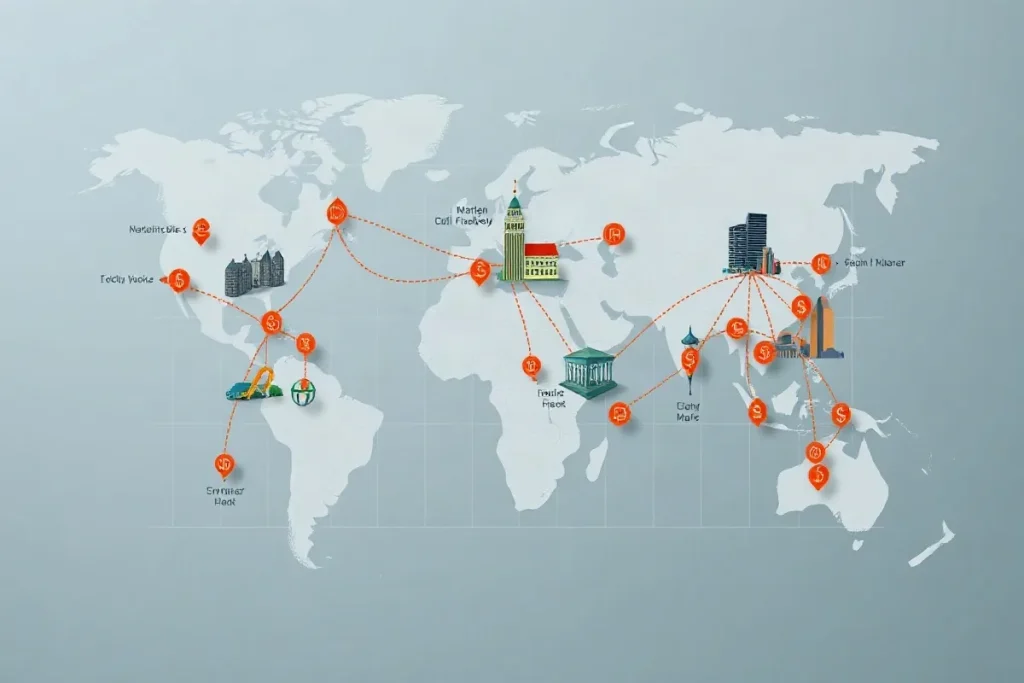
Money centres, often overshadowed by the more visible stock exchanges and banks, play an indispensable role in underpinning global financial stability. These hubs of currency trading, clearing, and settlement serve as the backbone of international finance, ensuring that capital flows smoothly and efficiently across borders. Without the seamless operation of these centres, the intricate web of global trade and investment would face significant disruptions, potentially triggering widespread economic instability.
At their core, money centres facilitate the rapid exchange of currencies and credit, enabling businesses, governments, and investors to manage risk and liquidity effectively. By providing centralized platforms for transactions and financial services, they help absorb shocks and prevent the cascading failures that can arise in more fragmented systems. Understanding why money centres are crucial to global financial stability means recognizing their role as both the engine and safeguard of the interconnected modern economy.
| City | Daily Transaction Volume | Key Payment System | Regulatory Framework |
|---|---|---|---|
| New York | $3 trillion | Fedwire Funds Service | Dodd-Frank Act (capital reserves) |
| London | £1.2 trillion | CHAPS | Basel III (CET1 ≥4.5%) |
| Tokyo | ¥500 trillion (~$3.7 trillion) | Zengin System | Financial Instruments and Exchange Act |
| Singapore | S$1.5 trillion (~$1.1 trillion) | FAST | Payment Services Act 2019 |
- $3 trillion Daily payment transaction volume processed by New York’s Fedwire
- €2 trillion Daily settlement value through the Eurozone’s TARGET2 system
- $25 trillion Annual global trade finance volume processed via money centres
- 4.5% Minimum Common Equity Tier 1 capital ratio mandated by Basel III for UK banks
- 540,000 Daily transactions processed by the New York Fed’s Fedwire Funds Service
Money Centres as Liquidity Hubs
Daily Transaction Volumes
Money centres serve as critical liquidity hubs by processing vast daily transaction volumes that underpin global financial stability. For instance, New York City’s Federal Reserve Bank handles more than $3 trillion in payment transactions every day, making it one of the largest liquidity facilitators worldwide. Similarly, Tokyo’s money market supports an average daily foreign exchange turnover of approximately ¥500 trillion, equivalent to about $3.7 trillion, highlighting its essential role in FX liquidity. These massive transaction volumes ensure that financial institutions and markets have continuous access to the funds necessary for smooth operations and risk management.
In Europe, the Eurozone’s TARGET2 payment system manages around €2 trillion in daily transfers, providing cross-border liquidity across 19 EU countries. This scale of settlement activity is vital not only for interbank payments but also for maintaining monetary policy transmission and financial market functioning across the region.
Key Payment Systems
Several specialized payment systems underpin the liquidity hubs of the world’s money centres. New York’s Federal Reserve Bank leverages its Fedwire Funds Service to process high-value and time-critical payments, maintaining operational efficiency and reliability. In London, the Bank of England operates the Real-Time Gross Settlement (RTGS) system, which manages approximately £1.2 trillion in daily settlement value, ensuring finality and certainty of payments within the UK financial market.
- Fedwire Funds Service: Processes over $3 trillion daily in the US.
- Bank of England RTGS: Handles around £1.2 trillion daily in the UK.
- TARGET2 System: Facilitates €2 trillion daily across Eurozone countries.
- Tokyo FX Market: Trades averaging ¥500 trillion daily, supporting global currency liquidity.
Influence on Monetary Policy Implementation
Market Operations
Money centres play an indispensable role in executing central banks’ market operations, which are critical for steering monetary policy. In Q1 2026, the New York Fed’s Open Market Desk conducted approximately $120 billion in Treasury purchases to uphold its targeted interest rate range near 5.25%. These transactions directly influence liquidity conditions in the U.S. financial system, enabling the Federal Reserve to manage short-term funding costs and guide economic activity. Similarly, the European Central Bank relies on the TARGET2 payment system to settle transactions tied to its €4.5 trillion asset purchase program, ensuring smooth liquidity provision across the Eurozone. This infrastructure supports the ECB’s efforts to maintain accommodative financial conditions amid ongoing economic uncertainties.
Rate Benchmarking
London’s financial centre remains pivotal in setting key benchmark rates that underpin global lending markets. The £SONIA overnight rate, which governs around £1.5 trillion in unsecured lending, is calculated daily through transactions conducted in this money centre, reflecting real-time cost of funds. This benchmark informs pricing on a wide array of financial products, from mortgages to corporate loans. Meanwhile, the Bank of Japan’s yield curve control policy has maintained 10-year Japanese Government Bond yields at approximately 0.1% since 2024, a strategy coordinated through Tokyo’s bond market infrastructure. These rates serve as anchors for monetary policy transmission by influencing borrowing costs and financial stability in their respective economies.
- New York Fed Treasury purchases: $120 billion in Q1 2026
- ECB asset purchase program: €4.5 trillion supported via TARGET2
- £SONIA rate impacts £1.5 trillion in overnight lending
- Bank of Japan’s yield curve control maintains 10-year JGB yields near 0.1%
Supporting International Trade Flows
Trade Finance
In 2025, global trade finance volume reached an unprecedented $25 trillion, underscoring the critical role money centres play in facilitating international commerce. London and Singapore dominate this landscape, jointly processing over 60% of trade finance instruments such as letters of credit and bank guarantees. These cities serve as key hubs where banks and financial institutions coordinate the complex credit and risk mitigation mechanisms essential to global supply chains. For example, Singapore’s financial infrastructure, supported by the Monetary Authority of Singapore (MAS), manages a liquidity pool valued at S$1.5 trillion ($1.1 trillion), which directly supports the smooth settlement of Asia-Pacific trade transactions.
Currency Settlement
The stability of international trade also hinges on efficient currency settlement systems. The New York foreign exchange market, with a daily turnover of approximately $2 trillion, remains the backbone for invoicing and settling trade in US dollars, the world’s dominant reserve currency. Meanwhile, Shanghai’s financial centre is rapidly expanding its influence, with cross-border RMB trade settlement surpassing ¥30 trillion in the first half of 2026 alone. This growth reflects China’s strategic push to internationalize its currency and diversify global trade financing options.
- Trade finance volume: $25 trillion globally in 2025
- London and Singapore: 60%+ share of trade finance instruments processed
- MAS liquidity pool: S$1.5 trillion supporting Asia-Pacific settlements
- New York FX market: $2 trillion daily volume for USD invoicing
- Shanghai RMB settlements: ¥30 trillion in H1 2026
Regulatory and Legal Frameworks Enhancing Stability
Capital Requirements
Regulatory frameworks in key money centres impose stringent capital requirements that bolster the resilience of financial institutions. In New York, the Dodd-Frank Act of 2010 mandates that major banks maintain capital reserves exceeding $250 billion, ensuring they can absorb shocks without destabilizing the broader economy. This substantial buffer is designed to protect against systemic risks by requiring banks to hold capital well above minimum regulatory levels. Similarly, London’s financial sector adheres strictly to the Basel III international standards. UK banks must maintain a minimum Common Equity Tier 1 (CET1) ratio of 4.5%, a crucial threshold that measures a bank’s core equity capital relative to its risk-weighted assets, thereby enhancing their ability to withstand financial stress.
Market Transparency
Transparency regulations play a pivotal role in promoting stability by improving market integrity and investor confidence. The European Union’s MiFID II regulation, effective since 2018, governs transparency for equity trading volumes worth approximately €24 trillion annually across EU money centres. MiFID II enforces strict disclosure requirements on trading venues and investment firms, facilitating better price formation and reducing information asymmetry. Meanwhile, Singapore’s Payment Services Act 2019 regulates fintech companies that oversee digital payment flows totaling around S$680 billion each year. This legislation introduces robust oversight for digital payment providers, ensuring secure and transparent processing of transactions in one of Asia’s most dynamic financial hubs.
- Dodd-Frank Act: >$250 billion capital reserves for major New York banks
- Basel III in the UK: minimum 4.5% CET1 ratio for banks
- EU MiFID II: transparency for €24 trillion in annual equity trading
- Singapore Payment Services Act: regulation of S$680 billion digital payments yearly
Technological Infrastructure Driving Efficiency
Payment Systems
At the core of money centres’ ability to maintain financial stability are their advanced payment infrastructures. The New York Fed’s Fedwire Funds Service exemplifies this with its capability to process an average of 540,000 transactions daily, each averaging $6 million in value. This high throughput is essential for enabling timely settlement of large-value interbank payments. Similarly, London’s CHAPS system handles an astounding £1.7 trillion every day, offering instant payment finality that underpins confidence in the UK’s financial markets. Meanwhile, in Asia, Tokyo’s Zengin System maintains a remarkable 99.99% uptime, processing around 25 million transactions monthly, ensuring round-the-clock reliability for domestic interbank transfers.
Transaction Volumes
The volume and speed of transactions handled by these systems highlight their critical role in global finance. Singapore’s FAST payment system supports 2.5 million real-time transactions every day, connecting over 200 financial institutions and facilitating immediate liquidity across the region. These high transaction volumes demand robust technological infrastructure capable of processing millions of payments swiftly and securely, reducing systemic risk. The combination of uptime thresholds like Tokyo’s 99.99% and transaction values, such as Fedwire’s $6 million average, illustrates how money centres leverage cutting-edge technology to support vast flows of capital continuously and reliably.
- Fedwire Funds Service: 540,000 daily transactions, $6 million average value
- CHAPS (London): £1.7 trillion settled daily with instant finality
- Zengin System (Tokyo): 99.99% uptime, 25 million monthly transactions
- FAST (Singapore): 2.5 million real-time daily transactions, 200+ linked institutions
Frequently asked questions
What defines a money centre in global finance?
How do money centres affect global liquidity?
Why is monetary policy linked to money centres?
How do money centres support international trade?
What role do regulations in money centres play?
Key takeaways
- Money centres process trillions daily, sustaining global liquidity.
- Central banks in hubs execute policies affecting worldwide interest rates.
- Global trade depends on money centres for currency settlement and financing.
- Regulatory frameworks in money centres enforce critical financial stability standards.
- Advanced payment systems in hubs ensure fast, reliable transaction processing.